Sunday, 10 April 2011

African Wings: Part 5 - Sandwich Harbour & Conception Bay


AFRICAN WINGS: PART 5: SANDWICH HABOUR & CONCEPTION BAY

Join us on a 6500km flying adventure through Namibia starting at Rundu on the Angolan border and ending at Oranjemund;  the quirky mining town of the Sperrgebiet
  

The dramatic coastline between Henties Bay and Sandwich harbour must be hands down, one of the most beautiful flights in the world...
We did a lazy take off into a shimmering haze of heat and dust late one afternoon and droned along the coast parallel to the desert highway between Henties Bay and Swakopmund. The heat was tremendous; 32 degrees on the ground and 32 degrees 2000ft above ground level. Now for non-aviators hot air means less lift for aircraft and on this particular day the air was so heavy with heat that it felt like we were flying through transparent jelly.

Following the desert highway between Swakopmund and Walvis Bay

The Desert road between Henties Bay and Walvis Bay

We flew over the bizarre little village of Vlotskasbaken which consists of extremely industrious and eccentric individuals that live “off the grid” and provide their own water and electricity in an exceptionally inhospitable environment. Each house is brightly coloured and themed, which gives the village a kind of fairground feel

The strange little village of Vlotskasbaken

The Ziela wreck just south of Henties Bay

Cargo ships in Walvis Bay harbour

Salt farming south of Walvis Bay

Where the dunes meet the sea

En-route to Sandwich Harbour

The landscape between Henties Bay and Swakopmund is characterised by barren salt pans, vegetation covered hummock dunes and endless dune fields that swirl along the coast kissing the sapphire blue Atlantic with their ever shifting sands.

The Kuiseb River Delta - a Wetland of International Importance

A Landrover negotiates its way over the dunes near Sandwich Harbour

Sandwich harbour is a shallow lagoon that lies about 80km south of Walvis Bay. It is a wilderness paradise that is virtually inaccessible by land due to spring tides and shifting sands. Historically Sandwich harbour served as a commercial fishing and trading port, however all that remains of these efforts is an early-to mid-1900s hut used for guano collection, a rusting barge, a graveyard and some wooden beams.

As we approached the towering, wind-sculptured dunes at the edge of the harbour; we felt like we had entered a land of enchantment, a place of sacred significance. Tumultuous, wild and unforgiving it stole our heart in a second. This visit to Sandwich harbour is one that we will keep locked away in our treasure chest of memories forever.


The surreal colours of Sandwich Harbour

Flamingo on the turquoise expanse of Sandwich Harbour

Flying over Sandwich harbour is something I am sure Dali would enjoy as its colours and shapes are so surreal in nature that you have to pinch yourself to make sure you’re really awake and not in some strange dream.

Further south at Conception Bay the famous ship wreck of the Eduard Bohlen came into view. She was a cargo ship that ran aground off the coast of Namibia's Skeleton Coast in 1909, due to thick fog. The wreck lies in the sand a quarter mile from the shoreline and epitomises the loneliness and savagery of the Skeleton Coast.

Dunefields south of Sandwich Harbour

The wreck of the Eduard Bohlen - her shadow the only memory of her former glory

The coastline between Sandwhich Harbour and Walvis Bay


The warm afternoon light had turned the dunes into molten gold as we flew back to Henties Bay. Jan and I sat in silence as we droned over the dune fields and the psychedelic lagoons,
humbled by the magnificence of it all……


Tuesday, 5 April 2011

African Wings: Part 4 - Walvis Bay & Sandwich Harbour


AFRICAN WINGS: PART 4: WALVIS BAY & SANDWICH HARBOUR

Join us on a 6500km flying adventure through Namibia starting at Rundu on the Angolan border and ending at Oranjemund;  the quirky mining town of the Sperrgebiet

We decided to use Henties Bay as our base for the next few days to explore the fascinating coastline south to Sandwich Harbour.
We woke up early to drive the long desert road between Henties Bay and Walvis Bay and got there just in time to catch “Flipper” a little boat that was to take us out into the harbour of Walvis Bay.
We had booked a sea and sand safari with Mola Mola, www.mola-namibia.com a safari company based in Walvis Bay. We were enthusiastically greeted by Andreas, our guide, who immediately insisted that we have a glass of old brown sherry to warm us up. You got to love the Germans and their early morning drinking habits.
The water was pastel blue and as silver as a mirror. An ethereal morning mist rose from the water in little eddies like dancing sea sprites. As we left the shore we were immediately joined by Great White Pelicans that came in on their tremendous wing spans like enormous army carriers. Flying low over the water they landed next to the boat with a huge splash, feet forward for braking. Their numbers grew till we had about 15 of them alongside the boat catching the fish we threw them in mid-air.


The Skipper and the Gull

Next was the large Cape fur seal colony on the sand spit encircling the Walvis Bay Harbour. Seal watching is exceptionally entertaining; they porpoise past you with curious expressions and as soon as they have an audience start showing off with flipper flaps, wave riding and water handstands.


Jan taking photographs of the seal antics


Andreas still doling out sherry, made his cheerful way down to the back of the boat, opened the bottom gate and out of the sea appeared a seal with a rheumy expression. She promptly slithered up the stairs and onto the boat with an agility that belied her size. I don’t know about you but I have never been within patting distance of a Cape Fur Seal and had no idea how enormous they are.


Her beautiful wet coat gleamed in the morning sun like oil and was exceptionally soft to the touch. Apparently seals have over 7000 hairs per square cm which makes their pelts highly sought after.

Seals on the Namib coast are on the decline due to climate change, competition with fisherman for fish and the unregulated and the barbaric seal cull. The annual Namibian seal cull has created much controversy and has been called the bloodiest and most savage seal hunt the world has ever seen with as many as 85 000 suckling pups being clubbed each year. (see below links for more information)
After trawling around the sand spit we were dropped off at Pelican point and picked up by khaki clad Nico and his rugged looking Landrover and headed off into the desert with the remote Sandwich harbour as our next destination.

The Kuiseb river delta and the lagoons between Swakopmund and Sandwich Harbour are a birders paradise. These lagoons have been designated as wetlands of international importance and are key nesting and feeding sites for thousands of visiting and resident birds including Flamingo, Pelican, Plovers and Terns. Some 40 000 birds - 34 different species - were recorded in this area during recent surveys.
Travelling through flat lands dotted with vegetated hummock dunes we popped out onto the beach and suddenly found ourselves travelling on a narrow strip between dunes and sea. Seagulls rose in waves in front of us and the milky orange dunes swept down gracefully to the crashing waves.

Where the dunes meet the sea

Kelp Gulls fly along the dunes searching for clams in the surf

Rescuing a fellow adventurer en-route

We reached Sandwich harbour and set off to climb a dune so we could really get a sense of our surroundings. After many breathless breaks we made it to the top and the view that met us was gob smackingly beautiful. Behind us were endless dune fields, in front a turquoise and sapphire bay dotted with flamingo and pelican. The contrast of the dunes, the lagoon and the remoteness of it all took our breath away.
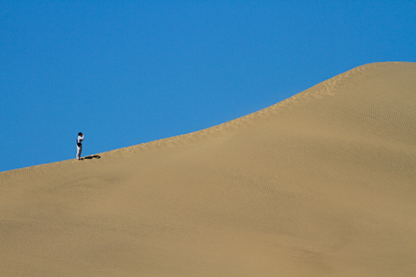
Climbing dunes requires calf muscles and sheer bloody mindedness


Jan on a dune at the rim of Sandwich harbour


A watercolour artists dream - the liquid lines of Sandwich Harbour


We ran and tumbled down the dune in a type of sun-kissed euphoria just in time for a champaign and oyster lunch. White table cloth and all was set out at the edge of the lagoon. The lovely salt air was a perfect accoutrement to our decadent lunch.

The drive back to Walvis Bay is not for the faint hearted and is better suited for roller coaster enthusiasts. We tore through the dunes in a way that felt more like gliding that driving. Up and down at impossible angles and curves, slipping down rumbling dunes we went, it was an example of superb driving by Nico and an awesome experience of what a Landrover can do.

The sapphire blue of the ocean contrasts spectacularly with the sensual dunes

There is nothing in this world quite as nice as hot sand between your toes


Riding the dunes between Sandwich harbour and Walvis Bay

Back in Henties Bay later that evening, we went back to our local hangout “Fishy Corner”, ordered another delicious meal and re-lived what we had experienced this magnificent Namibian day….

_______________________________________________
For current information on what is being done on Namibian Seal culling please read the article "Bloody Thursday deals first blow to Namibian Seal Cull" on:
http://www.informante.web.na/index.php?option=com_content&task=view&id=6570&Itemid=100
or visit the Seal Alert website to find out how you can help:
http://sealalertsa.wordpress.com/
Visit YouTube to view videos of this senseless slaughter:
http://www.youtube.com/watch?v=uzPcAvEARwI&feature=related


Friday, 1 April 2011

African Wings: Part 3 - Damaraland & the Skeleton Coast


AFRICAN WINGS: PART 3: DAMARALAND & THE SKELETON COAST

Join us on a 6500km flying adventure through Namibia starting at Rundu on the Angolan border and ending at Oranjemund;  the quirky mining town of the Sperrgebiet

 Our tanks were on empty but luckily our Jabiru 430 can take petrol (Mogas) and Avgas which makes it a perfect aircraft for flying in Africa. We had gone into Etosha the previous day and filled up our Jerry cans with petrol and after syphoning it into the wings with an old hose pipe we took off into a crisp golden dawn so typical of a Namib winter.

The dense bush of the Kunene slowly gave way to semi-desert and then to the ruggedly beautiful terracotta hills, mountains and valleys of Damaraland. The Damaraland is home to the famed Desert Elephant whom have adapted to survive the sun-baked and waterless wastes.

Leaving behind the bushveld of the Etosha and the Northern Kunene


The terracotta landscapes of the Damaraland


As we travelled south the imposing Brandberg or “the fire mountain” reared up out of the desert pavement below. Rising 2573m above sea level the Brandberg is a monolithic site and a place of great mystery and magic. Revered by the San for thousands of years this mountain and surrounding kopies have been lovingly painted with over 45 000 bushman paintings including the famous “white lady”
The Brandwag or "Fire Mountain"

Some say that Namibia is porn for geologists and when flying over the Damaraland and the sandy wastes of the Skeleton coast one can certainly see why. Quite abruptly the mountains and ridges of the Damaraland end and are replaced by what looks like a battlefield. The earth looked like it had been lashed with a cat o’ nine tails in punishment by some enraged God. The buckled and bent landscape melts into a flat empty expanse crisscrossed with prehistoric rivers stretching unbroken to the icy crashing waves of the Atlantic and the famed Skeleton Coast.

Prehistoric rivers snake across the desert


Namibia has been said to be porn for geologists

The entire coastline of Namibia was formerly called the Skeleton Coast but today it refers only to the Skeleton Coast National Park. Dense fog caused by the cold Benguela current meeting with the extreme heat of the desert shores characterise the early mornings and late afternoons along this enchanted coastline.
The Bushmen called the Skeleton coast “The Land God Made in Anger” and the Portuguese knew it as The Gates of Hell. Whatever you choose to call it, ever since European navigators first discovered it, ships have met their demise on this treacherous coast.
Flying over the sandy wastes is indeed a humbling experience and it was with relief that we spotted the sapphire blue sea which signalled that “civilisation” was not far ahead. We reached the coast at Terrace Bay and followed the coast south to Henties Bay where we planned to stay at a friends house for a couple of days.

The icy Atlantic crashing against inhospitable shores


The fascinating brine pans of the Skeleton Coast


The luminous colours and shapes of the brine pans


Flamingo flock in their thousands to the Brine Pans on the Namib coast


The enormous seal colony of Cape Cross


Henties Bay, a tiny desert village came into view and looked ludicrously isolated and fragile on the edge of such a savage coastline. We had to circle a couple of times before we located the airstrip which was virtually indistinguishable from the endless desert pavement surrounding it. We landed in a shimmering haze and taxied to the hangars, parked the plane on the leeward side and called Magda, a friend and local estate agent for a lift into town.

Sunset over the misty Henties Bay coastline


EZP parked next to a hangar at the Henties Bay "air-field"

Henties has the feel of a frontier town. Dirt roads, one petrol station, a couple of pubs, general dealers and a seafood restaurant or two are more or less what you’ll find on the main drag. One can see straight away that Henties is all about fishing and only about fishing!
We did a little grocery shopping, unloaded the supplies and went for a walk on the beach. The mist was just coming in and as we walked we couldn’t help but breathe the salty sea air in giant greedy gulps. After working up an appetite we headed off to the local restaurant and ordered a deep fried Kabeljou fillet with a large Tafel beer and spent the evening chatting to the local fishermen about this unusual place that they call home….

A lone fisherman in the ethereal afternoon mist at Henties Bay


Sunset over the Atlantic